A sudden surge of intense fear that peaks within minutes has a defined clinical meaning, while "anxiety attack" is an informal phrase people use for building worry or stress. That gap is the core of the panic attack vs anxiety attack question, and it shapes what kind of help fits.
If you just had an episode that left your heart pounding or your thoughts racing, you probably want two answers. What was that, and do you need to do something about it? The DSM, the manual clinicians use to diagnose mental health conditions, defines panic attacks. It doesn't list "anxiety attack" as a diagnosis, so the label you pick up online may not match what a clinician hears you describe.
This article sets the two side by side so you can compare timing, symptoms, and triggers. It also covers when chest pain or breathlessness deserves a medical check first, and how care steps up from self-care to therapy to a virtual intensive outpatient program. If you're in crisis right now, call or text 988, or call 911 in an emergency.
What does a panic attack feel like, and what do people mean by an anxiety attack?
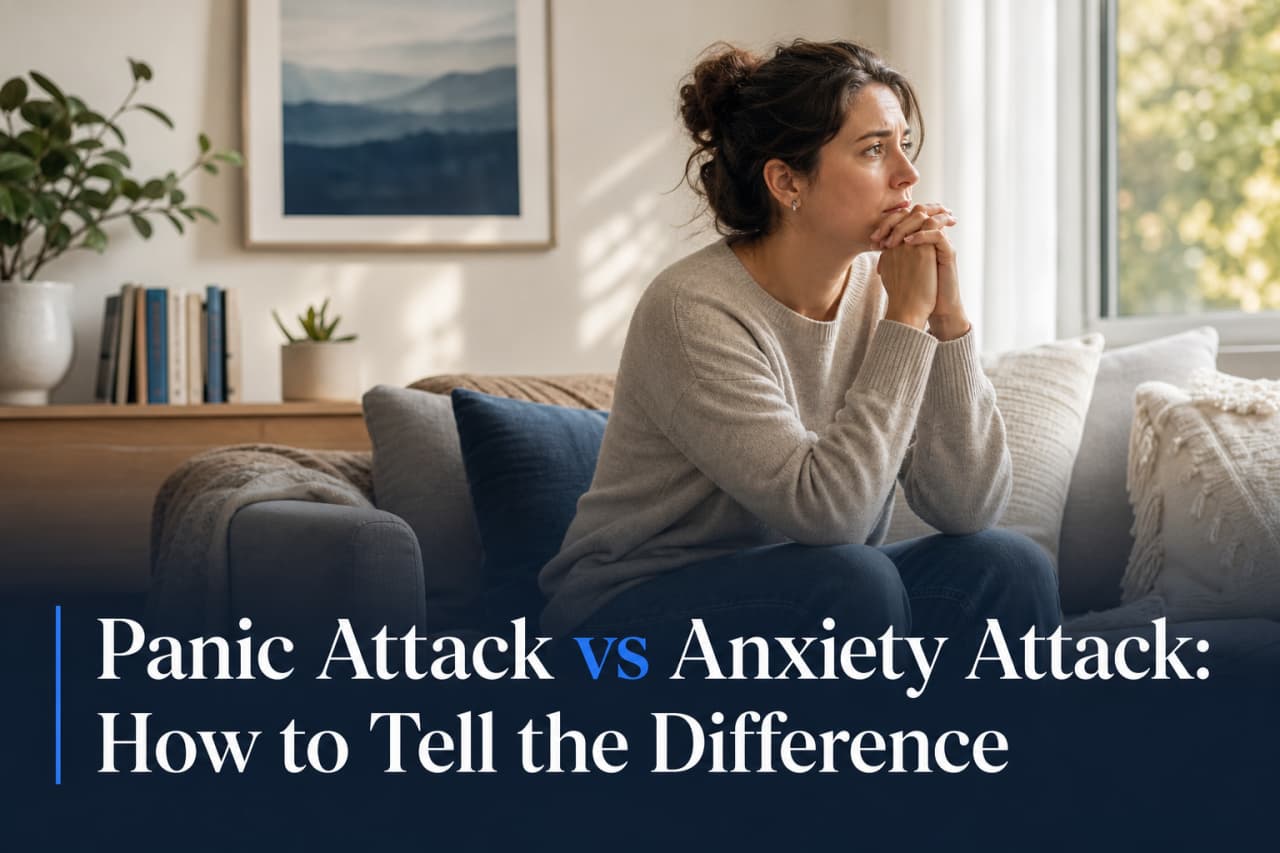
A panic attack feels like a sudden surge of intense fear that peaks within minutes, often with a pounding heart, shortness of breath, trembling, sweating, and a sense that something terrible is about to happen. The National Institute of Mental Health describes it as an abrupt rush of fear or discomfort that can arrive with no clear trigger, and it is a defined term in the DSM.
Many people also report chest tightness, nausea, dizziness, chills or hot flushes, tingling in the hands, and a feeling of being detached from their surroundings. Some fear they're losing control or dying. The physical sensations are real, and they're the reason so many first episodes end with a trip to urgent care. Most panic attacks fade within about 10 to 20 minutes, though the exhaustion and worry about a repeat can linger for hours.
"Anxiety attack" is different, because it isn't a clinical diagnosis. You won't find it as a named condition in the DSM. People use the phrase informally for a wave of worry or stress that builds over hours or days, such as before a deadline, after bad news, or during a stretch of poor sleep. The symptoms can overlap with panic, including a racing heart, tight muscles, restlessness, and trouble concentrating. The difference is usually pacing. Anxiety tends to climb gradually and attach to a specific concern, while panic hits fast and can feel unconnected to anything.
That gap matters because the label shapes what you do next. If you say "anxiety attack" to a clinician, they'll ask what you actually experienced: how quickly it started, how long it lasted, and what was happening beforehand. Those details help them tell panic attacks, panic disorder, generalized anxiety, and other conditions apart.
At Texas Mental Health Services, a clinician asks these same questions during a confidential assessment, which we use to match adults across Texas to a level of care by telehealth. You don't need the right vocabulary to call us. Describing what happened, in your own words, is enough to start.
Panic attack vs anxiety attack: how do onset, peak, and duration compare?
A panic attack arrives abruptly and peaks within minutes, while what people call an anxiety attack usually builds over hours or days and rarely has a sharp peak. That timing gap is the most reliable way to tell the two apart after the fact.
The table below sets the two side by side. "Anxiety attack" is an informal phrase, not a diagnosis in the DSM, so the right-hand column describes how people typically use the term rather than a clinical definition.
| Feature | Panic attack | "Anxiety attack" (informal) | |---|---|---| | Onset | Sudden, often within seconds | Gradual, builds with worry or stress | | Peak | Within minutes | No clear peak, intensity rises and falls | | Triggers | Can strike with no obvious cause | Usually tied to a specific worry or event | | Physical symptoms | Pounding heart, shortness of breath, trembling, dizziness, chest tightness | Muscle tension, restlessness, stomach upset, trouble sleeping | | Duration | Intense phase usually fades within minutes to under an hour | Can linger for hours, days, or longer |
Panic attacks also tend to carry a distinct sense of dread, such as a fear of losing control, fainting, or dying. Worry-driven episodes more often center on a concern you can name, like a deadline, a health result, or a family conflict.
The two can overlap. Someone with ongoing worry may have a panic attack on top of it, and a panic attack can leave behind days of anxious anticipation about when the next one will hit. Repeated, unexpected panic attacks combined with persistent fear of more attacks are what the National Institute of Mental Health describes as panic disorder, which is treatable.
You don't need to label the episode perfectly before asking for help. At Texas Mental Health Services, a clinician completes a confidential assessment to sort out what you experienced, and that assessment, not a search result, decides which level of care fits. If the episodes keep returning, our online anxiety treatment in Austin and across Texas is one place to start that conversation.
If you ever feel you might harm yourself, call or text 988, or call 911 in an emergency.
When should chest pain or shortness of breath be checked by a doctor first?
Chest pain, trouble breathing, or a racing heart that shows up for the first time should be checked by a medical professional before you assume it was panic. If symptoms feel severe, last longer than a few minutes, or come with pain spreading to your arm, jaw, or back, fainting, or confusion, call 911. Panic can mimic heart and lung problems closely, and only an exam can tell them apart.
Doctors often start by ruling out other causes. A basic workup may include a physical exam, a heart rhythm check, and blood tests, since thyroid problems, anemia, and some medications can produce the same pounding heart and breathlessness. Caffeine, nicotine, and stimulant use can also trigger similar sensations. Once those are cleared, a panic disorder diagnosis becomes more reliable. The National Institute of Mental Health notes that panic disorder involves repeated unexpected panic attacks and ongoing worry about having more.
Get seen promptly if any of these apply:
It was your first episode and you don't know the cause.
You have a history of heart disease, asthma, or lung conditions.
The chest pain came during physical effort rather than at rest.
Symptoms don't ease after 20 to 30 minutes.
A medical visit doesn't replace mental health care, and it doesn't mean your symptoms are "all in your head." It simply sorts out the body first, so you aren't treating the wrong problem.
At Texas Mental Health Services, we don't offer emergency, inpatient, or residential care. Our care is delivered by secure telehealth, so if you're having severe physical symptoms or think you're in danger, the right move is an emergency room or 911, not a scheduled appointment. If your doctor finds nothing physical and the episodes keep coming back, that's a reasonable point to ask about anxiety treatment, where our clinicians can assess what you're experiencing and recommend a level of care.
**Safety note:** If you're in crisis or thinking about harming yourself, call or text 988 (Suicide & Crisis Lifeline). In an emergency, call 911.
When is it time for anxiety treatment, and when does a virtual IOP make sense?
It's time for anxiety treatment when panic or worry keeps returning, makes you avoid places or activities, or interferes with work, sleep, or relationships. A virtual IOP makes sense when weekly therapy hasn't been enough but you don't need 24-hour care. Think of it as a ladder with four rungs, and you can start on whichever one fits.
The first rung is self-care and a medical check. Regular sleep, less caffeine, and slow breathing can take the edge off a single bad episode. If it happened once and hasn't come back, those steps may be all you need. If you haven't ruled out a physical cause for the symptoms, start with your doctor.
The second rung is outpatient therapy. Repeated attacks, constant fear of the next one, or growing avoidance are good reasons to see a therapist. Cognitive behavioral therapy and exposure-based approaches are the usual first-line options, and a medication evaluation can be added when a clinician thinks it would help. The National Institute of Mental Health describes psychotherapy and medication as the main treatments for anxiety disorders. Our online anxiety treatment and online CBT treatment pages explain how we deliver this care. Virtual Outpatient at Texas Mental Health Services runs 1-2 sessions per week.
The third rung is a virtual intensive outpatient program. Our Virtual IOP meets 3-5 days per week for about 3 hours per session, combining group therapy, individual therapy, and psychiatric consultations when clinically appropriate. It fits people whose symptoms are disrupting daily life despite weekly therapy, or who are stepping down from a higher level of care. For a closer comparison, read virtual IOP vs weekly therapy.
The fourth rung is care we don't provide. We don't offer inpatient, residential, or partial hospitalization care. If your needs call for that, we'll say so plainly and help you understand next steps.
Placement is a clinical decision made after a confidential assessment, and our team recommends the lowest effective intensity. You can also move between levels as you improve. Schedules and start dates are confirmed at intake.
**Safety note:** If you feel you might harm yourself or are in crisis, call or text 988. In an emergency, call 911.
Frequently asked questions about panic attacks and anxiety attacks
Can you have a panic attack without feeling afraid of anything specific?
Yes, a panic attack can arrive with no clear trigger, and many people describe it as fear that comes out of nowhere. The DSM describes panic attacks as abrupt surges of intense fear or discomfort that peak within minutes, and they can occur during sleep or in the middle of an ordinary day. A single unexpected attack doesn't mean you have panic disorder, but repeated attacks followed by ongoing worry about the next one are worth raising with a clinician.
Is an anxiety attack a real diagnosis?
No, "anxiety attack" is an everyday phrase and not a diagnosis in the DSM. People usually use it to describe worry or stress that builds over hours or days, sometimes with a racing heart, tension, or trouble concentrating. Clinicians look at the pattern behind the phrase, such as generalized anxiety disorder, panic disorder, or social anxiety disorder, and treat that underlying pattern. The National Institute of Mental Health describes the recognized anxiety disorders and their symptoms.
How long does a panic attack last?
Most panic attacks reach their peak within minutes and then ease, though you may feel drained or shaky for a while afterward. Building anxiety usually follows a different timeline and can linger for hours or days without a sharp peak. If you're unsure which one you had, jot down when it started, how quickly it intensified, and how long it lasted, then share those notes with a provider.
Should I go to the ER for chest pain during a panic attack?
Yes, if you have chest pain, pressure, or trouble breathing and you aren't sure of the cause, get medical care right away. Panic attacks can mimic heart and lung problems, and only a medical evaluation can rule those out. If symptoms feel severe or you think you may be having a medical emergency, call 911. If you're in emotional crisis, you can call or text 988 at any time.
Does anxiety treatment work if my attacks happen only occasionally?
Treatment can still help, because the goal is to understand the pattern and build skills before it grows. Cognitive behavioral therapy and exposure-based approaches are commonly used for panic and anxiety, and a clinician can also discuss whether a medication evaluation makes sense. Our online CBT treatment and online anxiety treatment pages explain how these approaches work in a virtual setting for adults across Texas.
How do I know if weekly therapy is enough or if I need an intensive program?
A confidential assessment is the way to decide, and our clinical team recommends the lowest effective level of care. Weekly sessions often fit when symptoms are manageable and daily life is mostly intact. A Virtual IOP, which runs 3-5 days per week for about 3 hours per session, can fit when weekly therapy hasn't been enough but you don't need 24-hour care. Our guide to virtual IOP vs weekly therapy compares the two in more detail. We don't offer inpatient, residential, or partial hospitalization care, and we'll tell you clearly if you need a higher level of care than we provide.
**Safety note:** If you're in crisis or worried about your safety, call or text 988, or call 911 in an emergency.
Selected references
National Institute of Mental Health: Panic Disorder
National Institute of Mental Health: Anxiety Disorders
Talk with our team
Reach out to our team to ask about an assessment or your next step. Contact Us