
Guides
August 1, 20269 min read
DBT Therapy Online in Texas and 20 Skills You Can Learn
Twenty DBT skills fall into four categories. Virtual skill practice can fit IOP or outpatient care for adults in Texas.
TMHS
Texas Mental Health ServicesAn emotion wheel groups feelings from broad core emotions at the center to more specific ones at the edge, so you can name what you feel with more precision.
Texas Mental Health Services
Editorial Team
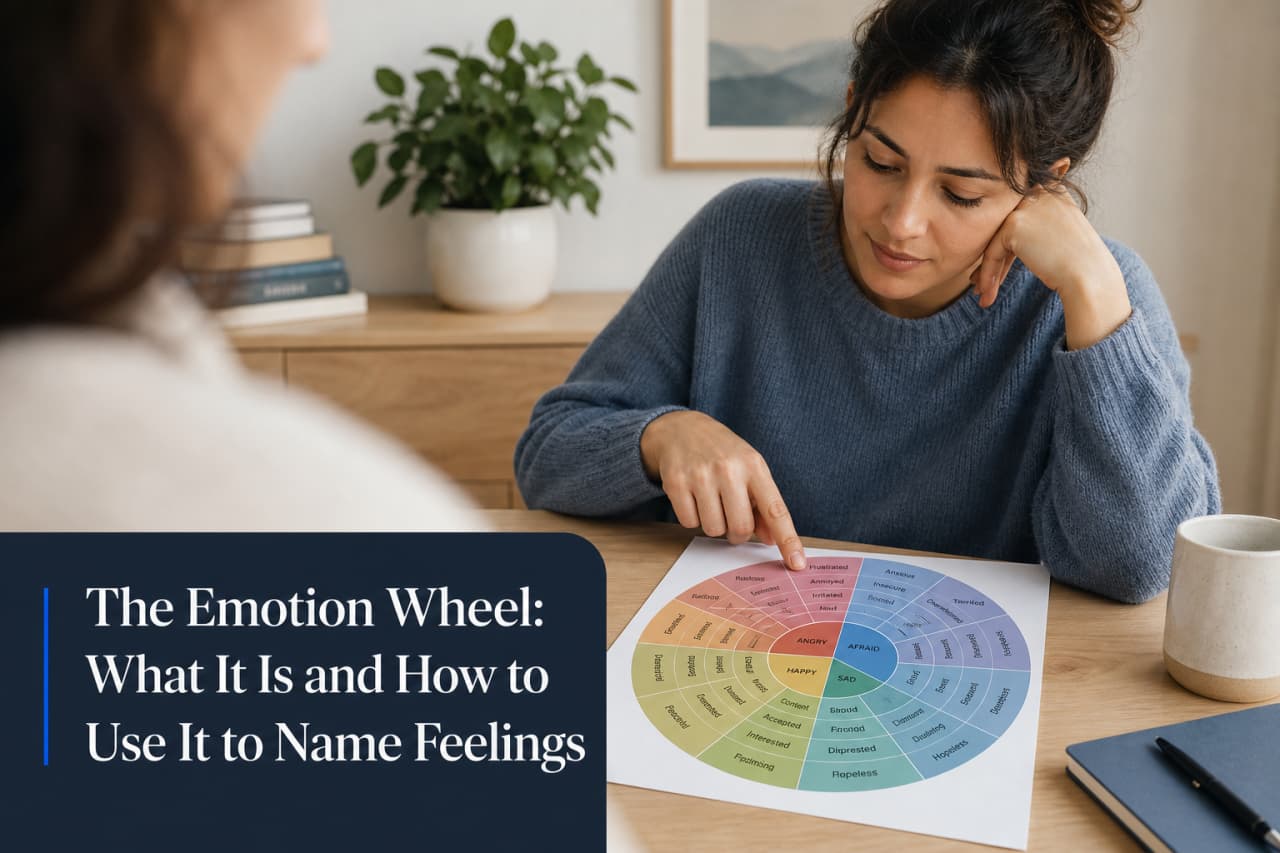
An emotion wheel groups feelings from broad core emotions at the center to more specific ones at the edge, so you can name what you feel with more precision.
Saying "bad" or "stressed" is easy, but finding the exact word for a feeling takes longer, and most people stall somewhere between the two. An emotion wheel starts with about five broad core emotions and branches into specific ones, giving you a ladder from the vague label to something you can work with.
Many adults never got much practice naming emotions, and the gap shows up in ordinary moments. You feel a tight chest before a meeting, or snap at someone you care about, and the only word that comes to mind is "fine" or "overwhelmed." A more exact word, such as disappointed, embarrassed, or lonely, points toward a different next step than a general one does.
This guide walks you through reading the wheel, using it on a hard day in a few minutes, and seeing how the same skill shows up in the DBT and CBT work our clinicians do. It is an educational tool and not a treatment, and we'll be straightforward about where it stops being enough.
An emotion wheel is a circular diagram that groups feelings by how specific they are, so you can move from a vague sense of "bad" or "off" to a word that actually fits. Most versions place about five core emotions near the center and branch outward into more precise terms toward the rim.
Picture the center ring first. It usually holds broad words like happy, sad, angry, afraid, and surprised, and some versions add disgust or a similar term. Each core emotion connects to a second ring of more specific feelings. Under sad, you might find lonely, hurt, or disappointed. Under angry, you might find frustrated, resentful, or irritated. Afraid might lead to anxious, insecure, or overwhelmed.
The third ring narrows things further. Overwhelmed might split into helpless or powerless, while frustrated might split into annoyed or bitter. The farther out you go, the more your word describes one particular experience instead of a whole category.
Wheels differ in how many emotions they include, which words they choose, and how they use color. We aren't attributing this tool to a single inventor, because many designs circulate and they don't share one source. Treat any wheel as a vocabulary aid and not a scientific map of the mind.
The layout works because a lot of people can pick a broad category faster than an exact word. If "sad" feels right but not quite right, the wheel gives you a short list of neighbors to test against your experience. That narrowing step is the whole point, and the structure matters more than the artwork.
At Texas Mental Health Services, our clinicians work with adults across Texas through secure telehealth, and putting feelings into words comes up often in therapy. A wheel gives you something concrete to point to when the right word won't come. It doesn't replace a conversation with a clinician, but it can make that conversation easier to start.
The next section walks through using the wheel step by step.
Start at the center of the wheel, pick the broad core emotion closest to what you feel, then move outward until you land on a more specific word that fits. The whole process takes a few minutes, and you don't need to get it perfect on the first pass.
First, pause and notice your body before you look at the wheel. Tight shoulders, a clenched jaw, a heavy chest, or a restless stomach are all data, and they often point toward the core emotion faster than thinking does. Write down one or two of those sensations.
Second, choose a core emotion from the center ring. Most wheels offer a small set, such as anger, fear, sadness, joy, and disgust, though the exact labels vary by version. If two seem true, pick the stronger one first and come back to the other.
Third, move to the middle ring and select the word that narrows it down. Sadness might become lonely or disappointed, while anger might become frustrated or resentful. Then move to the outer ring and test the most specific words against your experience. A good fit often brings a small sense of recognition, like "yes, that's it."
Fourth, say it in a full sentence, such as "I'm feeling overwhelmed because my week fell apart." Adding the "because" links the feeling to a situation, which is the same move therapists teach in CBT when they ask you to separate events, thoughts, and emotions.
Fifth, rate the intensity on a scale of 0 to 10 and note it. A rating gives you a baseline, so ten minutes later you can see whether the feeling has shifted, even slightly.
Finally, choose one small next action that matches the feeling. If you named exhaustion, that might be water and ten quiet minutes. If you named anxiety, it might be a slow walk or a call to someone you trust.
If you're working with a clinician, bring your notes to your next session. Our therapists can help you build this into your routine through individual therapy, and we confirm schedules and start dates at intake.
Naming an emotion with a specific word gives you something to work with, because a vague sense of "bad" can't be tracked, questioned, or acted on, while "disappointed" or "ashamed" can. Research on this idea, often called affect labeling, suggests that putting feelings into words can lower how intense they feel, though the effect varies from person to person and isn't a treatment on its own. The National Institute of Mental Health describes psychotherapies like CBT and DBT as approaches that build practical skills, and emotion identification sits near the start of both.
In DBT, observing and describing an emotion is a core part of emotion regulation. You notice the body sensation, the urge that comes with it, and the situation that set it off, then you label it in plain words. Accurate naming matters because the right skill depends on the right emotion. Anger that comes from hurt calls for a different response than anger that comes from fear. If you want to see how these skills are taught in a group setting, our post on DBT skills in a virtual program in Texas walks through the format.
CBT approaches it from the thinking side. A therapist will often ask you to name the emotion, rate how strong it is on a 0 to 10 scale, and then identify the thought that arrived just before it. Once the feeling has a label and a rating, you can test whether the thought holds up against the evidence. Without the label, that step is hard to start. You can read about how we use this method through our online CBT treatment in Austin and across Texas.
Clinicians at Texas Mental Health Services use CBT, DBT, and related approaches in Virtual IOP and Virtual Outpatient care for adults across Texas. Emotion identification usually shows up early, because every later skill leans on it. Our online DBT treatment covers how those skills are practiced week to week.
The emotion wheel is a good bridge between these methods. It gives you the vocabulary, and therapy gives you what to do once you have the word.
An emotion wheel can help you name a feeling, but it can't explain where the feeling came from, treat a condition, or replace an evaluation by a licensed clinician. It gives you vocabulary, and vocabulary is only the first step in understanding what's going on.
The wheel also simplifies. Real emotions blend, shift within minutes, and often sit alongside physical sensations that no diagram captures. You might feel relieved and guilty at the same moment, and a wheel that sends you outward along a single branch can make that mix look tidier than it is. If no word fits, describing the sensation in plain language is a perfectly good substitute. Cultural background and personal history shape how people label feelings, so a word on the wheel may not match how you'd describe your own experience.
Some signs suggest that a wheel alone isn't enough. Consider reaching out to a professional if you notice any of these:
The same painful emotions keep returning for weeks, even after you've named them.
Sleep, appetite, work, or relationships are being affected.
You feel numb or flooded most days, and naming feelings doesn't change that.
You're using alcohol, drugs, or other risky behaviors to get through the day.
Our clinicians use individual therapy to look at the patterns behind emotions, and we teach structured skills through CBT and DBT. Texas Mental Health Services provides Virtual IOP and Virtual Outpatient care for adults across Texas by secure telehealth, with offices in Austin and Rockwall. We don't offer inpatient or residential care, so if you need that level of support, we'll help you find an appropriate referral. Schedules and start dates are confirmed at intake.
If you're unsure which kind of support fits, the National Institute of Mental Health maintains a plain-language guide to finding help.
**Safety note:** If you're thinking about harming yourself or feel you're in crisis, call or text 988 to reach the Suicide & Crisis Lifeline at any hour. If you or someone else is in immediate danger, call 911.
Several emotion wheels exist, and they differ in layout, number of rings, and the feelings they include, so no single inventor owns the idea. We don't attribute the tool to one person here because we'd need a cited source to do that responsibly. What matters for daily use is that the wheel moves from broad core emotions toward more specific words, however a particular version is drawn.
No, an emotion wheel is a naming tool and doesn't treat any condition. It can help you describe what you feel more precisely, which is useful when you talk with a clinician or practice skills between sessions. If your feelings are persistent or interfere with work, sleep, or relationships, a therapist-led approach like individual therapy can give you structured support that a diagram can't.
Use it whenever you notice you can't name a feeling, and consider a brief daily check-in so the habit is familiar before a hard day arrives. There's no clinical dose for this tool. Many people find that practicing on mild moments, like irritation in traffic, makes the skill easier to reach when emotions run high.
Pick the closest word, then describe the feeling in your own phrase, such as "tight and on edge" or "flat and far away." The wheel is a starting point and not a test with right answers. You can also note where you feel the emotion in your body, which often gives you a clue the wheel's words don't capture.
No, but it supports the same first step. DBT skills training includes observing and describing emotions, and CBT work often begins with identifying thoughts and feelings in a specific situation. The wheel gives you vocabulary for that step. If you'd like to practice these skills with a clinician, you can read about our online CBT treatment, our online DBT treatment, or our guide to DBT skills in a virtual program.
Yes, many people find it helps when a feeling is hard to explain out loud. You can each point to a word and talk about what prompted it, without needing to agree on the cause. If conversations at home keep stalling, tell your clinician, since schedules, formats, and start dates for any services are confirmed at intake.
**Safety note:** If you're in crisis or thinking about harming yourself, call or text 988 (the Suicide & Crisis Lifeline). In an emergency, call 911.
Reach out to Texas Mental Health Services and ask about virtual care for adults.
About the Author
In This Article
Tags
Twenty DBT skills fall into four categories. Virtual skill practice can fit IOP or outpatient care for adults in Texas.

You'll see how a step-down plan works, what to ask the hospital team before you leave, and how to line up virtual IOP so there's no gap in care.

MHMR is the older name for Texas's community mental health centers, now called Local Mental Health Authorities and overseen by Texas HHSC.

Whether virtual IOP is safe depends on the program. Here are questions to ask about licensure, HIPAA, crisis plans and your space at home.

Compare individual vs group therapy vs IOP in one decision table.

Write the next level of care, follow-up dates, and response steps before IOP ends so your family knows what happens next.
Texas Mental Health Services offers client-centered services. Reach out for a confidential consultation and see exactly how we'd apply these strategies to your facility.