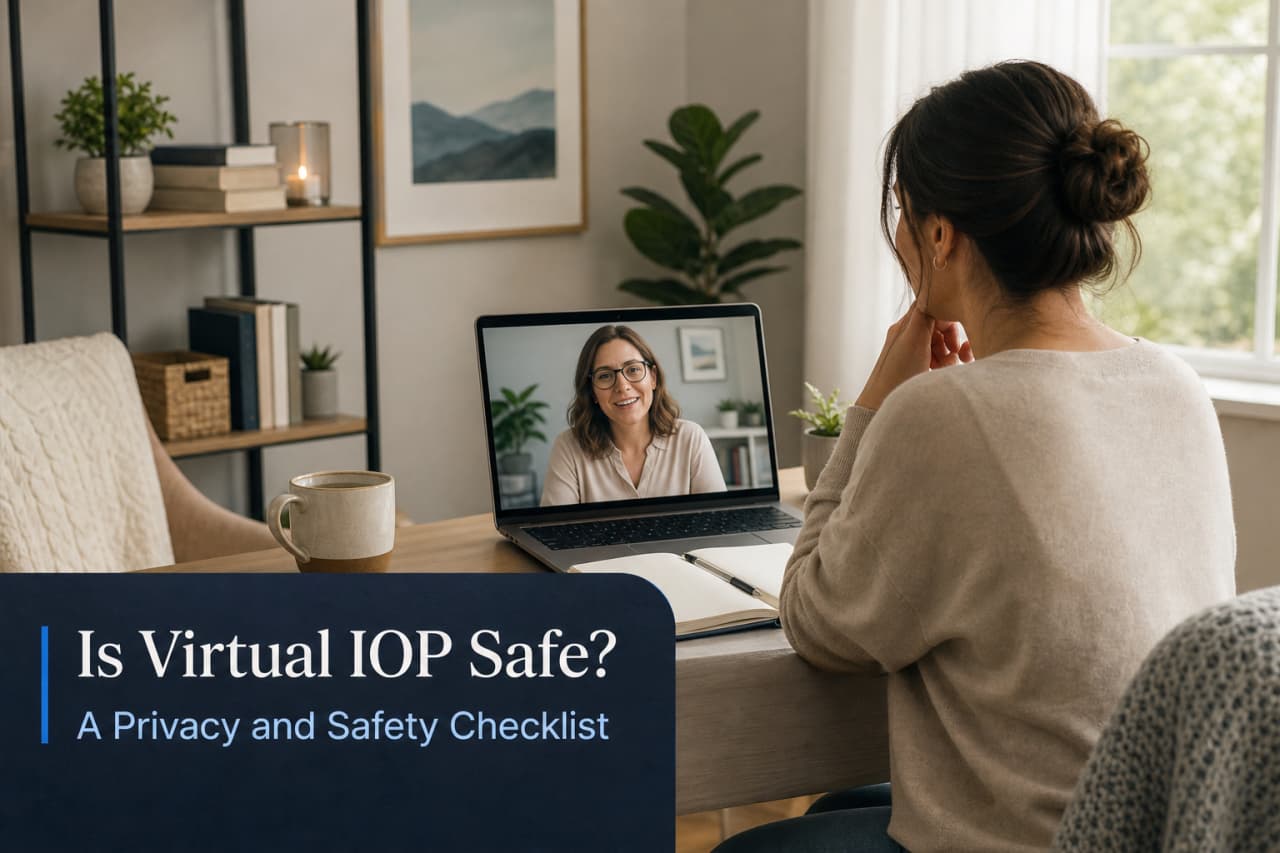
Anyone asking whether virtual IOP is safe should start with four things a program can explain to you directly: its licensure, how it handles HIPAA, its written crisis plan, and what you need at home for a private session. The answers vary by program, so the video format by itself does not settle the question.
People considering enrollment often want to know who can see their records, what happens if they are in distress while the clinician is on a screen, and whether therapy from home counts as real treatment. These are reasonable questions to settle before you commit. Our posts on research on virtual IOP effectiveness and what the first week of virtual IOP involves cover the clinical side.
This article focuses on what you can ask and check yourself, and you should hold any program, ours included, to the same questions. If you have thoughts of harming yourself or are in immediate danger, call or text 988, or call 911.
Is virtual IOP safe? A four-part checklist for judging any program
The four checks below are a practical starting point, not a complete list: licensure, HIPAA handling, a written crisis plan, and a private place at home. Each one is a question you can put to a program before you enroll.
Start with licensure by asking for the names and credentials of the clinicians who would treat you, and whether each holds a current license. If a program mentions accreditation, ask which organization granted it.
HIPAA is the federal privacy rule that governs health information, including care delivered by video. The U.S. Department of Health and Human Services publishes HIPAA and telehealth guidance for providers. Ask the program to explain in plain language who can see your chart and how your information is stored.
Because your clinician is not in the room, you will want to know the plan for a bad moment in specific terms. Ask what happens if you become unsafe during a session, who gets contacted, and how you reach help between sessions. A private space at home is your part, since software cannot stop a roommate or family member from overhearing a session.
If a program cannot answer one of these questions clearly, consider that a reason to keep looking. Our virtual intensive outpatient program page describes our format.
Virtual IOP is not a substitute for emergency treatment. If you're in crisis, call or text 988, or call 911 in an emergency.
How is my privacy protected in telehealth under HIPAA, and what is my part at home?
HIPAA applies to health information whether care happens in an office or over video. The U.S. Department of Health and Human Services publishes HIPAA guidance for telehealth that describes how providers are expected to handle remote care. It is fair to ask any virtual IOP provider how it meets those requirements.
On the provider side, you can ask how video sessions are conducted and whether they run on a secure platform built for healthcare. You can also ask who can see your records, how long they are kept, how you can request a copy, and what happens to your information after you leave. Get the answers in writing if you can.
Group sessions deserve a separate question, because other participants will see and hear you. Ask how the program sets confidentiality expectations for the group. Our post on what to expect in the first week of virtual IOP is another place to start.
At home, software cannot protect a conversation that a roommate overhears. Consider a room where you can close the door, headphones so others cannot hear the clinician's side, and a device and network you control rather than a shared or public one. If your home is crowded, tell your care team early so you can talk through options.
If you can't find a truly private spot, raise it with any program before you enroll. Many people face this problem, and there is no reason to feel embarrassed about it.
What happens if I am in crisis during a virtual session?
Ask to see the program's crisis plan before you enroll. It should say who to contact, what steps to take, and when a session shifts from treatment to emergency response. If a program cannot describe its plan in plain terms, that is a concern worth weighing.
Questions worth asking include whether the plan records the physical address where you will be during sessions, so help can be sent if the video drops. Ask whether it names an emergency contact you have agreed to, and whether it lists warning signs and coping steps that fit you personally. Also ask what happens if you stop responding or the connection ends during a difficult moment.
If you're having thoughts of harming yourself, you do not have to wait for your next session. Call or text 988 to reach the Suicide & Crisis Lifeline, or call 911 if you're in immediate danger. SAMHSA explains how the 988 line works and what to expect when you reach it.
Virtual care has a real limit here. A clinician on a screen cannot physically be in the room with you, so people in active danger, or who cannot keep themselves safe between sessions, may need a higher level of care than virtual IOP. A clinical assessment is the right way to decide that.
Accreditation does not replace asking about the crisis plan itself. You can read how our Virtual Intensive Outpatient Program is structured, and our admissions process page describes how enrollment works.
What should I ask a provider before I enroll?
Ask for licensure, accreditation, a crisis plan, and an explanation of data handling in writing or on a recorded intake call. Specific answers give you more to go on than general reassurance.
On licensure, ask whether each clinician who will treat you holds an active license and what credential each person has. Ask who oversees your care plan and who prescribes if medication management is part of it.
On accreditation, ask which body accredits the provider and whether it covers telehealth services.
On the crisis plan, ask what the program does if you become unsafe during a session, who you call between sessions, and how it confirms your physical location. If the answer is only "call 911," keep asking. You want to hear steps and people, and when a higher level of care would be recommended.
On data, ask who can see your records, how long they're kept, and whether sessions are recorded. Ask how you would request a copy of your chart and what happens to your information if you leave. Compare the answers with the notice of privacy practices you receive.
Ask about fit too, including weekly hours, what a typical week looks like, and how groups are run. Our post on what to expect in the first week of virtual IOP covers this. If cost matters, ask about insurance verification before you commit.
You can see how enrollment works on our admissions process page, and the format is described on our virtual intensive outpatient program page. Any provider you consider should welcome these questions.
FAQ: Common questions about virtual IOP safety and privacy
Is virtual IOP as safe as in-person IOP?
Safety depends on the specific program and on your situation, not on the format alone. A key difference is that your clinician cannot physically be in the room, so safety planning deserves extra attention. Ask any program how it confirms your location and emergency contact, and see what to expect in the first week of virtual IOP for the early weeks.
Can someone else see or hear my sessions?
Anyone in your physical space may be able to see or hear your sessions, so a closed door, headphones and a private network can help. On the provider side, HIPAA governs how your health information is shared. The U.S. Department of Health and Human Services explains how HIPAA applies to telehealth in its HIPAA and telehealth guidance.
Is virtual IOP real treatment, or a watered-down version?
Ask any program what services it includes, such as individual therapy, group therapy and oversight by licensed clinicians, and judge it on those answers. Our page on the virtual intensive outpatient program describes our structure. For the research side, see is virtual IOP effective.
What if I'm in crisis during a session?
Ask your program how it responds before you enroll, and ask that its written crisis plan cover confirming where you are and reaching emergency help. Outside of sessions, you can call or text 988, the Suicide & Crisis Lifeline, or call 911 in an emergency. SAMHSA's 988 resources explain what to expect when you reach out. If acute safety concerns come up regularly, a higher level of care than virtual IOP may be a better fit.
Does insurance cover virtual IOP, and will my employer find out?
Coverage varies by plan, so verify your benefits before you enroll. You can start with our insurance verification page. When insurance is billed, claims and explanations of benefits can reach the primary policyholder, so ask about that before you enroll.
What if I'm still unsure about enrolling?
You can contact our team with questions before deciding anything. Our admissions process page describes how enrollment works.
Safety note: If you're thinking about harming yourself or you're in crisis, call or text 988 anytime, or call 911 in an emergency.
*Educational information only, not medical advice.*
Ready to talk with our team?
Reach out to our team with your questions about virtual IOP.
Contact Us
Selected references
U.S. Department of Health and Human Services, HIPAA and telehealth guidance
SAMHSA, 988 Suicide & Crisis Lifeline